
WiP it...
Whip it Good
I had a conversation with one of my editors a couple of weeks ago, about writers going onto Substack…
“It’s great, she said, but I can’t escape the feeling they’re posting stuff their editor has rejected” “
And of course, to a large extent, that’s true. Though one can spin that to say, yes … but we’re also putting out things that we enjoy working on, that might never have fitted even the preliminary specifications of your publication. As a Substack reader, I really hope that’s true too.
But it also cuts straight to my major personal reservation about Substack. Putting something into a semi-public domain that, for whatever reason, hasn’t passed by another set of professional eyes, is akin, for me, to that dream where you’re standing on stage in assembly at your old school and you’ve forgotten your clothes.
I think … I hope… that people read this kind of thing with that in mind. No … not me, naked in The Hall at Bristol Grammar School; the understanding that most of what’s here is, if we’re being generous, WiP.
Last month we ran a piece in the FTMag about Succession at St John. I’m pleased with it, and it was a joy to write, but it’s part of something bigger. I’ve got quite close to Fergus and Trevor over many years. Perhaps not quite a full member of the St John Family, but semi ‘embedded’. Pretty much since the beginning, I’ve been writing everything down, in one place. Several articles have come out of it, but it’s an unwieldy beast of a thing - more a resource than any kind of structured meta-piece.
This chunk began as an intro in the first draft the FTMag piece. An iteration where I tried to talk about British restaurant history on an arc based on my personal relationship with the place over its long life. The way I work on longer pieces, this is not unusual. That draft got up to about 5k words, and we only had space in the mag for 2.5k. It was easy to lop off early. Then there was another draft entirely constructed around a stretched metaphor of a monastic/chivalric institution. I confess that was largely because I got obsessed with the title ‘The Order of St John’. Then a version based on Fergus’s favourite book ‘Master and Commander. Homeopathic traces of all of them survive in both the final draft and the published version.
My editor saw none of those. Just the final draft. If she had, she would have been entirely correct to expunge them as completely irrelevant to the commission and the audience (as well as intolerably solipsistic)
So, this isn’t strictly rejected material. It’s just some stuff that reads reasonably well that was used on the way to something else, written for another purpose … if that makes sense.*
Growing up with St. John
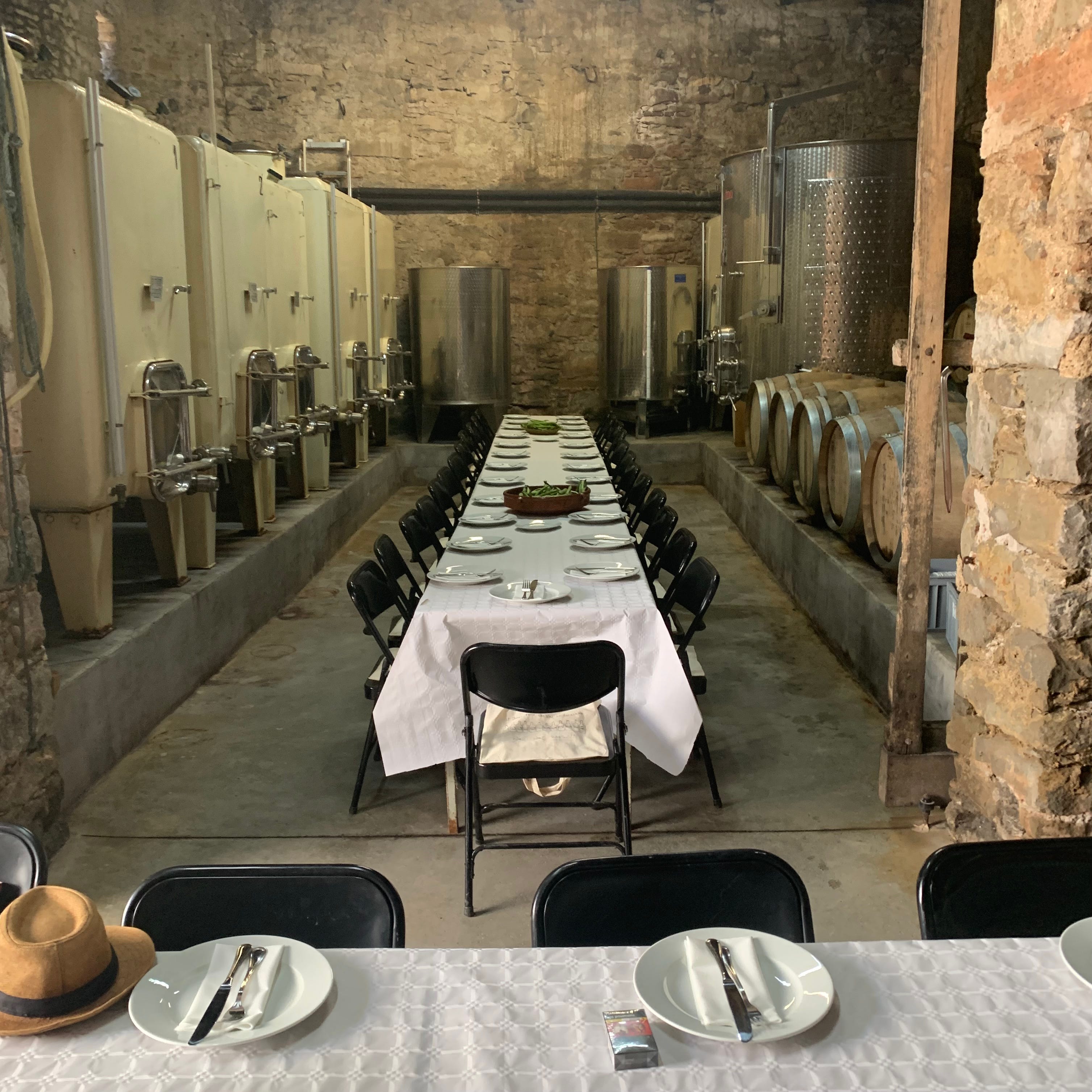
We were sitting outside a cafe in an unremarkable town in the Languedoc. A lot of restaurant people. A little subset of cynical hacks, a squad from Drakes, the menswear temple on Jermyn St, a few unaccredited, local randoms, and a cadre of wine pros who’d flown halfway round the world. A weird but brilliant crowd.
This was the 2024 St John Fete du Vin. An annual party thrown by Trevor Gulliver, winemaker, importer and half of St John restaurant and Fergus Henderson; other half, chef, sage and saint of British cookery. Probably no one else could have brought such a strange group together. Halfway down the ninth anise somebody asked me …
‘So where do you fit into all this? What’s your St. John story?’
It’s a weird but perfect question. You’re not really being asked about a restaurant. It’s not the standard conversational gambit of ‘how do you know so-and-so’? When somebody asks you about your relationship to St John, they’re asking about a whole broader thing … the recent history of British food. Our much talked about Food Renaissance. It’s like, “So what did you do in the war, old man?”
I sought out the restaurant just after I moved to London. I guess I was a nascent ‘foodie’ because I’d somehow heard about Fergus and his cooking upstairs at the French House in Soho. I’d certainly heard stories about offal. It must have been around the turn of the century because Gordon Ramsay and Jamie Oliver had already started appearing on the telly - the historically accepted climacteric. Yet St John had already been open for a couple of years. Fergus had already been diagnosed with Parkinson’s disease and was beginning to move gently on from the kitchen.
When I finally walked in, it was unlike anything I’d ever experienced. Thonet-style bentwood chairs. A line of Shaker pegs around the room. A tablecloth with a paper topper. Today, the “whitewashed industrial” aesthetic is so prevalent in hospitality as to be a cliché, but then it sent a shiver through you. Henderson had trained as an architect, they said. He insisted on honouring the bones of a building the same as he would respect the parts of a pig. It was audacious and, as we were all just beginning to find ourselves as a nation of food lovers, it also seemed, well, incredibly British.
I bought the book that day. Back then, I think you could only buy it at the restaurant. We weren’t yet drowning in celebrities and their cookbooks, and those early copies had something of the underground press about them. Today, these editions are worth a fortune. Mine’s too bloodstained and beloved to ever sell.
As I sat at the table, orienting myself in the thrillingly austere setup, I could see the people I would later know as Trevor, Fergus, and John Spiteri, but my focus was entirely on the waiter. I don’t remember his face. Just the white jacket. It was like a chef would wear. His manner was respectful but warm, and the conversation informed, but utterly informal. He described the food, not just like he’d tasted it, but that he loved it, understood it, and wanted to give me some of it.
It was an interaction with St John, sure enough. It was on-brand. But it also encapsulated everything I grew to love about our nascent food scene. For the first time, it wasn’t ‘them and us’, like our parents would have experienced in restaurants they saved to visit. Places where people were inherently unlike us. They were French people, Italians, cooking food we barely understood. They sneered as we made mistakes in choosing wines that scared us.
This waiter … this kid … was just like me. He was wearing the jacket of a cook; he was serving perfectly; he was looking me slap bang in the eye and we were talking about food we loved. It was as if every moment of the traditional hierarchy of hospitality had evaporated and I was instantly and irretrievably at ease. The democracy was disorientating and thrilling. I wish I knew who that waiter was, because, to be honest, the rest of my life began at that moment. But then, of course, it wasn’t just the waiter… it was the whole St John thing, and I’d somehow entered it.
I had my stag dinner in the PDR at St. John. It was such a special meal I invited my fiancée and her mates too. It was an enormous success and, a couple of years later, we moved into a run-down doer-upper just south of King’s Cross, a vile hole but redeemed by fashionable proximity to St John.
One evil night I took an American friend along. We drank staggering amounts. I think he despoiled the basement bathroom with gallons of Cotes du Rhone vomit. As we weaved blindly to the door, I saw Fergus and Trevor sitting at a table by the front door, quietly and proprietorially minding their own business. I fell to my knees in front of them and babbled. A baffling and probably nauseating display, but I just didn’t have words in that condition to express thanks for what this temple meant to us. I never made it the 500m back home that night. I woke up in a doorway at about 4am without my wallet or my dignity.
Let me tell you one of my favourite London restaurant legends. During its early blossoming, St John became, for a while, the unofficial clubhouse of a contemporary art crowd. Tracy Emin, Jake and Dinos Chapman, Damien Hirst and other YBA’s, were regulars, and there were, the story goes, excellent parties. It was at one of these events that the now feted ‘Banksy’ executed a ‘work’ on one of the temptingly blank walls of the restaurant.
According to the legend, Fergus sincerely thanked him for his charming rat and, by the following morning, had had it neatly painted over, returning the room to the calm temple of food it had been and remains to this day.
This remains the only piece of restaurant art I can truly enjoy. That it’s there, hidden by a thick layer of ‘Architect’s White’, silently ‘interrogating’ the value or indeed the point of art in a dining environment. The most exquisitely cunning ‘conceptual piece’ I can imagine.
Writing for the Guardian got me an assignment to be filmed cooking with Fergus. My diary says August 2009, but it can’t be that long ago, surely. We bought half a pig head at the market and spent most of the day slow cooking it ‘alligator style’… one baleful eye, unblinking on the surface of a rich braising stock. Shallots and watercress on the plate. Parkinson’s was slowing his speech, but the meal went on for the entire afternoon. We talked about cooking, about the respect inherent in nose-to-tail eating, but there was more. An afternoon of easy conversation taught me more about eating, enjoyment and hospitality that any other event in my life.
You’ll read a lot about St John’s influence over chefs, but to me that was just a tiny part of the impact. It affected all of us: home cooks, restaurateurs, designers, and writers. It feels like St John has been there from the very start of the renaissance and now we sit, comfortably established, at ease with our national food identity. We’re serious now, ready to move on with confidence. St John has been there with us for the whole journey and now I’m watching them like a hawk. I want to know what’s next. Where St John goes, I shall follow.
* In the absence of a sub, I can be reasonably sure that my spelling isn’t hopeless by using a good spell-checker - I don’t really want to use any of the tools that might recommend preferred grammar or style. It feels like the old Microsoft Paperclip, but written by tech bros. Secretly (I hope no editors are reading this) I think idiosyncratic grammar and punctuation might be our primary advantage over LLMs.
Gotta love a Devo reference
I love that first book as much for its symbolic nature: it marks the time I kept my first pigs and, after 17 years of meat-free existence, I wanted to honour the whole beast(s) not only through lack of waste but by making deliciousness the result of their extremely happy, long, loved lives.