
I needed to take a quick warm break for… well frankly for reasons of sanity.
I genuinely couldn’t face the total ballache of travelling across Europe, where everyone - quite understandably - hates us. My problem was that, having grownup in a British seaside town, I am constitutionally incapable of buying into the sprawling myth of the Great British Seaside.
People in Hackney justify a glamping holiday in Devon, because they still believe in a the Famous Five origin myth. Cubs scouts, picnics, fêtes, caravans, ice cream, fish and chips. But when you grow up in a town where the only source of income is tourists, you acquire a particularly bleak outlook. Other nations don’t seem to have this problem and generally smile upon visitors as they empty their wallets. Here in the UK, anyone who lives in a town that attracts tourists is honour bound to loathe them with peculiar intensity. They need your money desperately … but they really want you to die horribly.
There was, predictably, nothing to book in the entire country, save a last minute vacancy at the Carbis Bay Estate, about which I knew absolutely nothing … though it’s website seemed to offer hospitality without any of the usual signifiers of resentful miserablism.
But then I mentioned where I’d booked to my Mum.
“Oh my goodness. The Carbis Bay! When I left school and joined the Typing pool at The Road Transport and General Insurance Co. all the girls would ever talk about was getting married and having their honeymoon at Carbis Bay. It was the best hotel in the country”
(In writing this, I discovered something absolutely lovely. Mum and Dad got married at 18 and 19yrs old (I was born a year later). They had absolutely no cash for a honeymoon so, after the ceremony, headed off in a cloud of confetti, for one night at The Skyline hotel in Heathrow, then quietly pushed off for a week in the basement of a B&B in Margate).
Maybe booking Carbis Bay was a good idea.
I didn’t have a trainset as a kid and it’s a loss I feel more keenly as I get older. One day, when all my marbles are completely misplaced, I might spend all my daughter’s inheritance on an attic full of HO/OO, with tiny models of postmen and hundreds of sets of points that never work. One day I might buy the hat and the whistle … but until then there’s still Devon or Cornwall.
I know moors and waves crashing on rocks are the Cornish things that St Rick of Rock can bang on about at length, but what fires my synapses is that thing where you’re looking out over a bay or estuary and then, quite suddenly … a tiny train enters the scene from one side or the other. It doesn’t chuff. They don’t do that anymore. But in my head I hear the unique scuttering, scrabbling sound of the wheels of a particularly impressive model train trying to grab some traction on their tiny rails. I love that noise. Sounds like somebody electrocuting a spider on ice-skates.
In spite of appearances, Carbis Bay wasn’t built by Hornby, but GWR… the Great Western Railway, who, bless them, built the hotel on the Carbis Bay Estate, and served it with its own branch. The St Ives Bay Line runs four and a quarter miles, from St Ives to St Erth. It stops at the glittering fleshpots of Carbis bay and, unbelievably, has a request stop at Lelant Saltings, possibly for those who find the Urban grit of St Erth too ennervating.
If you grew up in Bournemouth, you’d recognise the hotel. The classic late Edwardian genteel pile. The sort of place Indian Army Colonels and fragile Aunts might retire. Though now it’s been thoroughly Farrowed &, almost certainly, Balled, the main thing today is - and in fact, always, has been - the view. It might be the UK’s only ‘private ‘ bay. The hotel looks out over a perfect curve of bright sand and turquoise sea. Punctuated with a modest lighthouse at either end. Were it not for the curvature of the earth, the only other thing you’d see would be Newfoundland. There is agricultural land occupying parts of the curve and a very distant and small caravan park. But basically, for the price of a room, what you see is yours alone. You might imagine a setup like this on maybe the Australian Gold Coast or Thailand. But you couldn’t afford it.
The hotel is family-owned and still has a very special low-key charm to it. They are very proud to remind you that the G7 was held here in 2006 and that Boris (of evil memory) was a regular guest.
Carbis Bay estate has obviously put a lot of thought into their food offering. It’s vertically arrayed up the cliff face. Down at sea level there’s a great ‘Beach Club’, open to those members of the public with the determination to get there (the beach is public). There’s a more brasserie-style restaurant called ‘Walter’s on the Beach’ that feels like more of an ‘occasion’ spot and has a great cocktail bar. There’s a deli for coffee, sandiches and pastries. Up at the top, the main hotel ‘orangery’ does a proper breakfast and, half way up, Mor has all the trappings of a serious, International ‘destination’ restaurant.
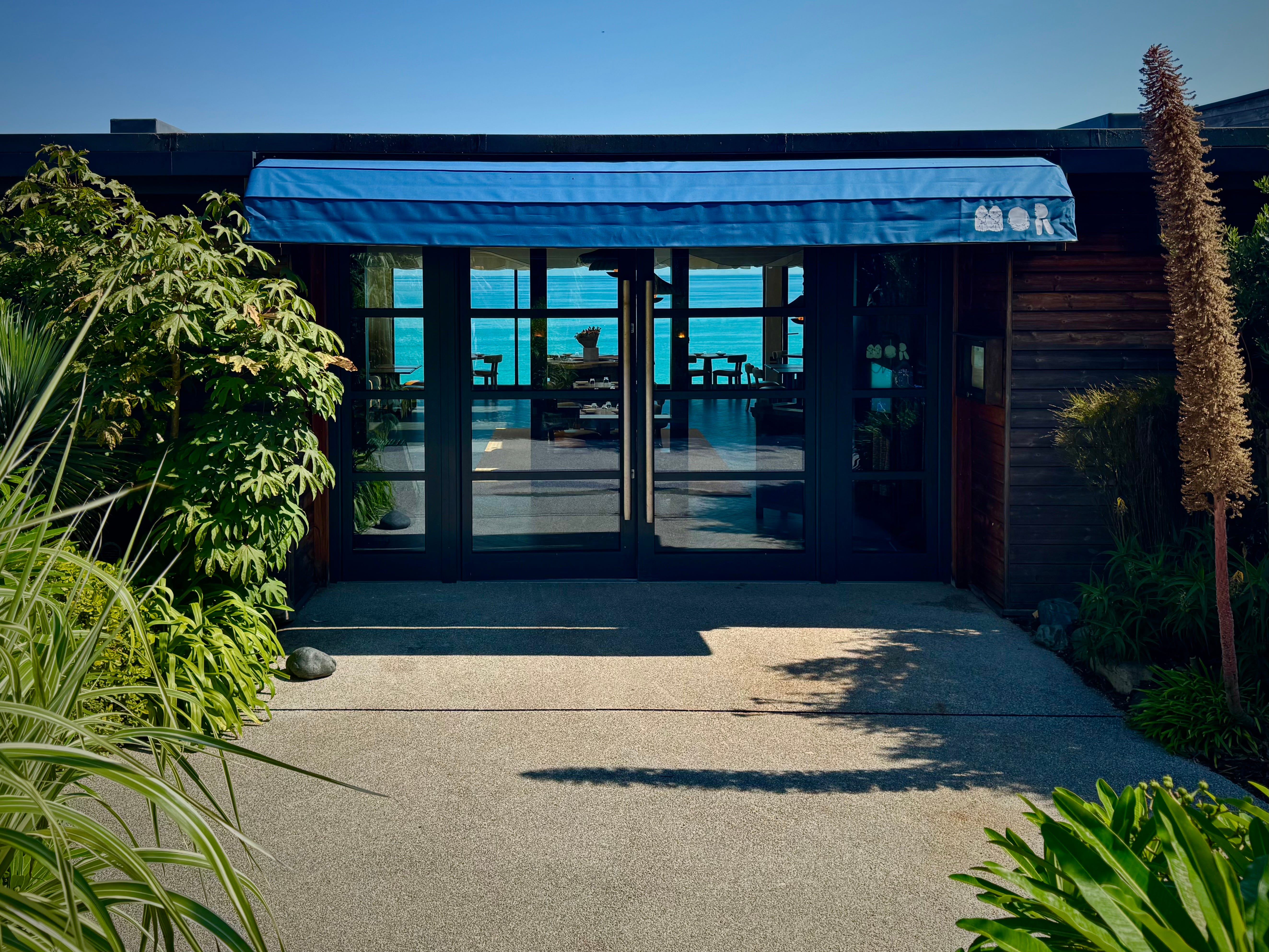
You walk out of the back of the hotel, down over what must once have been terraces, parterres, possibly ramshackle steps to the beach and suddenly you’re looking through the most perfect dining room I’ve ever seen. Perched in the cliffs, maybe 25m above the sand. You walk in through the doors at the bottom of the stairs and the entire bay opens before you.
It’s a world class room. Which is possibly why, for the last few years it’s been run along Michelin lines by Adam Handling, but it’s now being rethunk, and relaunched by Tom Sellers, through Executive Chef Tom Anglesea.
I’d planned to head back home an unfortunate day earlier than the soft opening but I couldn’t help but watch the complicated stages of setup. Eventually they spotted me pressing my nose against the glass and I got invited in by Tom Anglesea.
I’m going to be honest here. I held this back because I wanted reviews to get out from people who’d actually tasted the food. To be clear… I ate nothing at Mor. And yet it felt like one of the most significant restaurant visits I’d made in an age. (So significant, I didn’t want it mistaken for a ‘review’).
It was at least a couple of decades ago that I walked into another restaurant, on the outer spiral arm of nowhere, with an insane view over the sea and talked to a young chef I’d never met before. It was inspiring because it was the first time I’d heard someone talk about food like I felt about art; who had the cojones to believe he could bring something new and significant to an unsuspecting world by expressing his personal vision through innovation and technique.
Sitting at Mor’s PDR table at 0800 with a cracking double espresso and a 180 degree of lapiz lazuli Atlantic was one of those moment when you pinch yourself… I cannot believe I get to do these things. The crew… a mix of long-service pros from London restaurants and local kids, were unpacking their new uniforms. A kind of utility suit designed by Finisterre, a design and clothing company based a few miles along the coast. Their joy was unbridled, seductive and basically gorgeous. I sat there sucking my espresso and feeling my cynicism fall away like that time they dropped Kierkegaard into basket of labrador puppies.
Anglesea was knackered. But he, too, in spite of having spent every waking second of the last God knows how many months, wrestling this place into shape - patently couldn’t believe his luck.
We talked for half an hour or so, about his people, about the mechanics of the new design, where the view leads but everything else is designed to either physically display the fresh ingredients or to expose the processes of cooking. He has left himself nowhere to hide. But what shone through was his tone.
This chef wasn’t talking about how he was going to impose his personal vision, but how thrilled he was to work in such an environment, with such people and such ingredients. This Michelin-quality space has evolved away from multi-course set menus to something much more accessible, warm and to me, a much more fascinating angle on what hospitality is all about.
The menu is awesome, but I’ll leave reviewing to someone who’s tasted it. Suffice it to say, they’ve worked themselves to nubs sourcing from the seas and countryside around them, and Anglesea is refreshingly focussd on the idea that the cooking should be faultlessly brilliant - a given - but as simple, as unfussy and as honest as possible. The menu, as a result, is ALC and arranged so you could do a Boris and spaff squillions, or bring in your very lucky family and escape with change for an ice cream on the beach tomorrow.
I can’t tell you how important this felt. It was like brackets at either end of an era. The ends of an arc. At the beginning a young chef just about realise he can turn a small, honest local seaside restaurant into Michelin, at the other another young chef who thinks that, in spite of the Michelin setting he’s inherited, that’s not what people want anymore. That’s not where Mor is aiming.
What really impressed me was Anglesea’s attitude. I’ve met very few chefs who sounded like him. The two that spring to mind are Jonathan Woolway at the Shed in Swansea and James Ferguson at the Kinneuchar Inn in the East Neuk of Fife. Quiet men with huge talent, disinclined to thrust themselves into the spotlight, but with a bone deep desire to make people happy with their food.
The room, the ingredients, the people, and no clumsy ‘Michelin strategy’ to insert itself between Mor and my enjoyment of it? I don’t need to eat to know I have to go back. If this is what the future is like, I’m very much here for it.
If I was getting paid for this, I’d probably call it ‘The New Humility’.
I went for lunch on Friday and spent today writing my piece for Good Food Guide. I went over my word count by about 100 per cent I liked it so much. It's probably even better than you would imagine. You should definitely go back and eat.
It sounds utterly sublime and just what people have been waiting for.