
The Shooting of Cherry Manhattan
I’ve just come to the end of the photographic part of the book project - the most fun I’ve had in years. Having the opportunity, the gear, the space, and most importantly the time to rediscover taking pictures has been unexpectedly fulfilling.
One of the best things about an art college education in the last century was that they put you in a building that had probably been designed by Ruskin... they gave you kit, and they left you the hell alone. My ‘classroom’ was a gorgeously vaulted, north-light floor in a Victorian ‘Institute’ or spacious high rooms with total blackout and an infinity of lights on wheels.
There were whole days when all that was expected of you was to stick a person or a thing in front of the camera and fiddle until everything looked beautiful.
After I graduated, I had a crack at photography as a career. A couple of years of being hazed and abused as an assistant, a few pages here and there, a lot of self-funded, speculative work... but when other opportunities came up, I seized them. I mothballed my gear, followed a waitress to the States and never really looked back.
For years, I didn’t take pictures at all. I’d grown to dislike all the processes that kicked in every time I stuck my eye against a viewfinder. In fact, it was only really when Instagram arrived and I started using a decent iPhone that some ease, maybe some of the old learning, quietly slid back in.
I’m not quite sure when The Cocktail Hour became a photographic project. Because I would spend a day researching a cocktail, writing about it, mixing it, and finally drinking it, it made sense to take a picture. Because a cocktail is a small, static thing, it’s shot on a modest scale, controllable, and intentional. In the same way that you think about making the drink all day - about its story, its components and how very, very good it’s going to taste - you think about about glassware, props and lighting and how very good you can make it look.
Food photography for magazines and books used to be done on large format cameras. That meant a lot of artificial light was needed. That meant studios, long exposures, and food that didn’t degrade over the hours it might take to capture a shot. Elizabeth David famously hated photographs of food because she felt words described it better. Looking at the magazine spreads of her time, she was absolutely right. Words conveyed the enjoyment of ‘living’ food. Photography for her was the artificial representation of dead food.
My particular speciality was fashion. Until the early 60s, fashion photos had also been large-format, studio-based, immensely static shots of a very artificial-looking model in a perfect dress. Beautiful, unreal ‘product’ shots. But as soon as young photographers and art directors took advantage of the new ‘miniature’ 35mm cameras, everything changed. Models were taken out onto the streets... to ‘locations’. They were encouraged to move. To smile, to have fun, and suddenly a fashion photograph wasn’t really about the dress anymore; it was about the vicarious enjoyment of the ‘lifestyle’ portrayed. About how you could feel if you wore it.
Perhaps because digital is so much more forgiving than film, I reckon it’s done the same thing to food photography as 35mm did to fashion. A shot is about capturing the spirit of the moment. Naturalness, location. A digital camera makes a phenomenal image in low light, handheld. It can be taken where food is being enjoyed. It can capture a dish the second it looks at its best, as it hits the table. Portraying not ‘dead food’ but helping the viewer to imagine what it would feel like to eat it. No longer a ‘product shot’ but an aspirational image of a lifestyle. And it’s so much better.
But a cocktail’s going nowhere, not moving about, not rapidly degrading. It is, like one of those incredible couture dresses, a designed product. So I found myself using artificial light. The lights led to longer exposures, so things could no longer be shot handheld. The camera went onto a tripod. It’s very difficult to make a drink in a glass look good without substantial back light, so I moved my bench-top ‘set’ so it backed on to a window and built a frame into which I could slip panes of vintage glass that I’d dug up in reclamation yards.
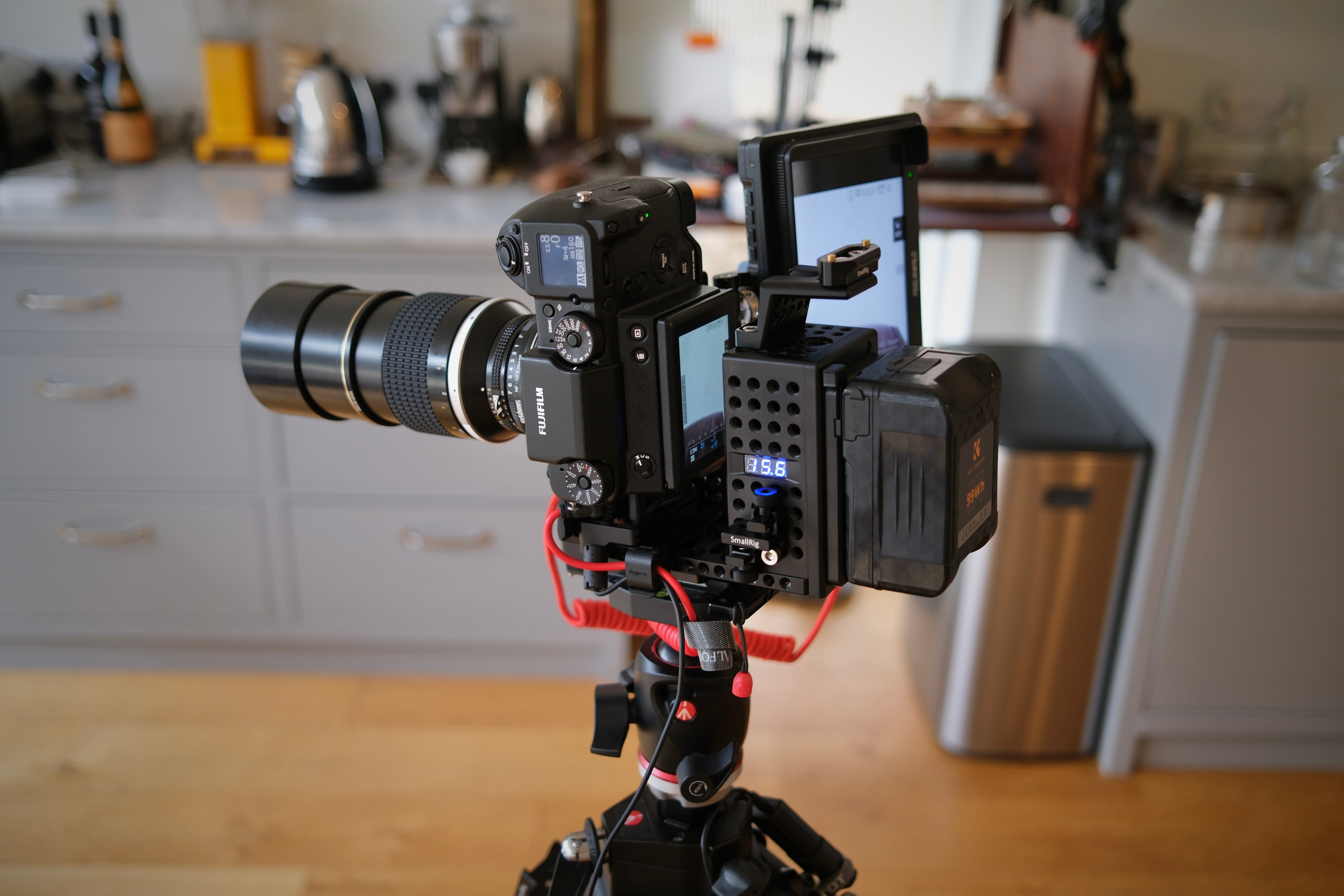
Modern book production requires very high-quality digital images so, much as I’d have loved to shoot on film, it would have been impossibly costly, time-consuming, and required far more reshooting. But I really wanted to work with the old lenses that I knew well from my apprenticeship, so I got myself a secondhand Fujifilm GFX50s. It’s a slightly out-of-date ‘medium format’ mirrorless digital camera that can capture very large image files. But more importantly, it was the first digital that allowed free use of all sorts of old lenses via a network of geeky enthusiasts designing aftermarket adapters. It’s an unwieldy arrangement. Too heavy to handhold but superb for old-fashioned ‘studio’ work.
I dusted off the old Nikon 35mm lenses (Nikkor 180/2.8 ED, Nikkor 105/1.8, Nikkor 85/1.8) and Hasselblad medium format lenses (250mm f5.6 Sonnar, 80mm f2.8 Planar, 50mm f4 Distagon); workhorses dating back to the 60s, that were already knackered and second-hand when I bought them as a student. Now they’ve gained scratches, hazing, fungus and a tremendous patina of age that somehow brings a soft organic quality to the pictures that modern glass seems to lack.
Because the old lenses can only be manually focussed, I use a large screen ‘focus assist’. Because I don’t work ‘tethered’, there’s a battery pack and, yes, a while ago, I flipped the image on the focussing screen and put a darkcloth over my head to set up a shot. Yes... I have gone full circle. Right back to that weird, forgotten ‘still-life’ thing of just sticking something on a table, in a dark room, with zero context and a few lights. Staring. Really looking. Tweaking and fiddling, considering every setting, checking, double-checking and thinking long and slow before exposing maybe a couple of frames.
But there’s more to it. Taking the picture is now the penultimate step in a chain of appreciation. Understand the cocktail, prepare, build, contemplate the drink, and nobody’s kidding anybody that the appearance doesn’t affect your final enjoyment.
So I look at it... in the same way a civilian does... Mmmmm. That looks good! Then I put it into the set, flick on some lights, tweak everything to make the drink, the glass, the garnish look as good as I can. Box-breathe, concentrate, and pull the trigger.
I pick up the cocktail and take it over to the computer screen... and before I take the first sip, I know that I have done everything in my power to make that vital image as perfect as it can possibly be.
Like I said... the image affects the taste. And I’ve optimised it. I look and I drink. And I take full appreciation of the unfair advantage I’ve created.
Tonight, there was no more need to shoot... the MS is closed... the book is on its way to the presses. But I made myself a Reverse Cherry Manhattan, and to enjoy it absolutely fully... I shot it.