
The New Food Writing
Naah! Not Really. But a bit of Gonzo might be the only thing between us and the grey tide
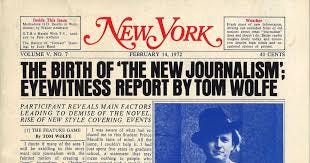
I think I must have been in my 20s and living in San Francisco when I picked up a very well thumbed second-hand copy of Tom Wolfe’s “The New Journalism” and was instantly, irrevocably hooked.
I’d never had the slightest notion of writing. As a kid, my handwriting was so bad that I rarely finished an exam paper. I loathed and feared ‘writing’ so much as a physical process that it never crossed my mind that most of it went on in the head.
But the ‘New Journalism’ just blew me away. People who wrote in such a fluid... kind of un-mannered way. Capote, Thompson, Talese, Southern, Herr, Didion. I just drank them in. My US copy was two broke back inches thick, and I took it in two straight sittings. Then I started at the beginning and did it again.
By the end, I knew exactly what a writer was and what they did. I still didn’t think I’d ever have the faintest chance of doing it... but God, I wished I could.
I read a couple of chapters again last night. Old favourites. Tom Wolfe, “Radical Chic and Mau-Mauing the Flak Catchers and, naturally, “The Kentucky Derby is Decadent and Depraved” by Hunter Thompson.
I guess like every other hack, my brain is boiling these days with thoughts of LLMs and losing our gigs in a tsunami of slop... and this is the first time I’ve revisited the Old Masters since the Rise of the Machines.
What really struck me was this. Turns out I never gave a toss about the Kentucky Derby. Nor Khe Sahn. Nor Black Panthers at Leonard Bernstein’s flat. Nor Frank Sinatra, Ava Gardner, Mohammed Ali. None of the actual content of the stories stuck.
This was what really pissed off the Old Guard and thrilled Wolfe... and me. What all these writers had done was bypass the rigorous detachment of traditional journalists. They hadn’t just failed to professionally quarantine themselves from their subjects; they threw themselves in and wallowed like hogs. It’s precisely why I didn’t give a fart about the moral right and wrongs of a motorcycle gang; I wanted to either be Thompson, or be with him as he experienced one.
That was what was ‘new’ about the New Journalism, and a lot of it looks dated and overblown now. But it changed everything, and we can’t go back.
For the last couple of days, the full PR Squadron of the Ramsey Empire has been on manoeuvres, trying to spin up some sort of beef/mince about restaurant critics. Particularly how they’ve lost all their influence to, well ‘Influencers’.
It’s a daft, half-squib of an idea, but it leverages his unpleasant and aggressive personality to promote his collaboration with TopJaw. I don’t know where you stand in the debate; I certainly don’t know where I stand, but it’s very noticeable that Rameses still couches his carefully reasoned critique in the notion of restaurant writers sitting in judgement. And he measures success on how that judgement affects consumer behaviour.
“Critics don’t have the skills/right to judge, and nobody listens to them anymore anyway”.
It’s very true that an online thing can put many more customers into a restaurant than a written review. But I don’t think anyone writing about food in the UK has positioned themselves as an arbiter, or seriously believed that they could reliably affect footfall, for years. That’s not what it’s about anymore.
Anyone who thinks that a critic’s opinion is that significant to a business probably also believes that the people who read our recipes actually cook them. The adman in me really hates it, but we basically don’t understand how our work is being consumed.But I’m starting to think that maybe the immersion specialists, the embedded, the Gonzo writers had a clue.
A vanishingly tiny number of specialist nerds want to cook our recipes or visit the restaurants we get to visit. Like a tiny number of people want to get stomped by Satan’s Slaves at an acid-fuelled 3-day party at Bass Lake. But millions want to do it vicariously with someone they can like, someone who speaks to them as an equal, someone who makes them laugh, or think, or feel.
It may be one of the ever more desperate and crumbling intellectual defences against Artificial Intelligence, but, I don’t reckon a machine can ‘be the person who wrote it’.
If you think about good writers, columnists, even one or two critics, there’s a symbiotic thing between their work and their person (I don’t want to say ‘personality’ can we settle on Imago?). The work reinforces the mental image of the writer; the writer writes themselves more and more into the story.
An AI can’t ‘go’ where the thing is happening; it can’t convince a reader that it’s been there.
I think this might be one of the few intangibles that machines can’t conquer. On a physical, intellectual, or philosophical level. They can’t ‘lie’ that they were there. Will readers accept something that’s written with a ‘personality’ that doesn’t exist. What are publications going to do? Make up a name for a sclerotic old soak? AI a masthead picture of his ravaged features and retcon a life of unremitting self-abuse?
Like the early ‘New’ journalism, food writing is reported experience. It’s not about the precision with which you predict the next mot juste - which LLMs do so very well. It’s not even about forming a well reasoned argument which LLMs can manage with astonishing ease. It’s about being there. Which LLM’s can’t.
Food writing is immersive and experiential. It’s not about the precision with which you predict the next mot juste - which LLMs do so very well - it’s about being there. Which LLM’s can’t.
An AI can already turn out a reasoned thousand on Cabbage-based foodways and Eastern European Identity. An AI can do a very usable consumer report on a restaurant - well researched from customer reports on TikTok, and actually rendered into readable English. An AI can find three reasonably correlated examples and extrapolate a ‘Hot-Right-Now’ filler. But food/politics writing has always been cripplingly otiose; reviews that attempt enumeration and forensic examination of multiple courses, value for money, and the cleanliness of the toilets have always been useful but criminally tedious. Trend pieces have always been shit. But we can let the AI’s deal with those.
Until your laptop can eat a pie, get arseholed, stagger home and bang out 900 words on the experience that you actually want to read, then we’ll always stay the last line of defence. Bravely stuffing ourselves and then, with rather too much relish, telling you how it felt.
I stumbled upon your restaurant column while wasting an afternoon on my employer's FT subscription. It was like discovering some new thrilling drug amid the office tedium, despite having zero interest in food writing. Thanks for keeping Gonzo alive and for passing on your excitement for something I thought I didn't care about. Your line describing a "phalanx of prawns huddled around a Parisian pissoir" to illustrate a cocktail-glass starter is high art. I look forward to LLMs doing better.
Amen.
I wrote in my editors letter for the WA Good Food Guide this year:
We are human, not driven by an algorithm. Tech cannot taste and feel in the way that we can; it cannot observe a service or connect with a sommelier over a recommendation that’s just blown your mind. We don’t reduce critical thinking to thumbs up, thumbs down.
My extended version would read that, AI cannot feel the strain of too much butter, nor can it have conversations with a GP about whether this throbbing toe is gout. It cannot sit bolt upright in bed at 2.53am autopilot engaged as you throw yourself towards the hotel bathroom, thankful as you wretch long and hard that you didn't puke on the handmade and unique to each room silk wallpaper. Because this is what it is to be human, and to be someone who gets paid to eat, write, repeat.