
Bourride is a whole bunch more interesting than bouillabaise.
There. I said it.
I’ve already got 10 points on my Middle Class License so I basically I haven’t got a hope.
But it’s true!
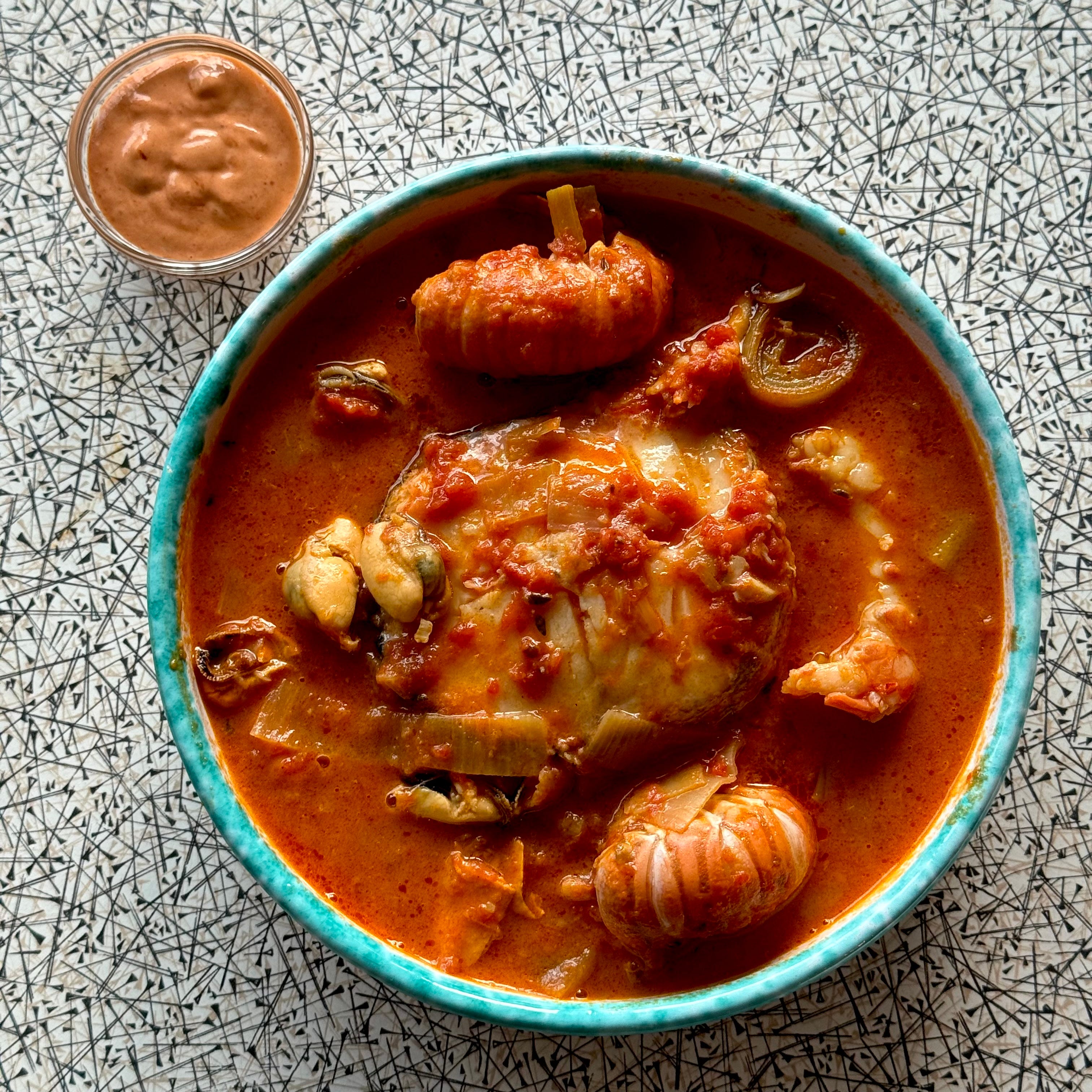
Bouillabaise is a recipe - or more correctly a series of hotly defended recipes - codified by a cartel of expensive restaurants for tourists in Marseille. The “Marseille Bouillabaisse Charter”, was created by a collective of local restaurateurs in 1980 to “safeguard the traditional recipe and serving methods of the iconic Provençal fish stew”.
Bourride isn’t a recipe at all. At least not in the sense of a foolproof list of ingredients, quantities, times. It’s a foodway that’s found all over the coast of the Med... and not just the French bit.
Bourride is a rough technique that people who work around fish developed to make the most of by-catch, discards and trim. It is, therefore, infinitely superior.
I will not be taking questions.
If I have my facts straight, Cambridge is the city in this sea-girt isle farthest from all available saltwater. This means that most clouds have dropped their water by the time they reach us, giving us the lowest precipitation, usually less than 250mm pa, making us, iirc UK’s only ‘temperate desert’. So I’m thinking of getting good at grilled lamb and couscous... but my desire to own a small fishing boat is a total bust.
So I don’t have ‘by-catch’.
Except that I do!
Today I was working with the estimable Kenneth Lam on a shoot for an article about fish stews. I had a terrific haul from Waitrose fish counter, the blokes on the stall in the market and via courier Rockfish in Brixham. It was a ludicrously grand catch and I hadn’t even had to don an oilskin and get salt in my beard as I hauled on ropes. I didn’t even sing while I did it. (I’m avowedly Anti-Shanty)
So I built a bourride with my by-catch.
I beat down some leeks, garlic, saffron and thyme in olive oil. Added a can of tomatoes and cooked it down for 20 minutes. Then I added half a bottle of wine and a litre of water (it should have been seawater but, you can’t drink the Cam without some kind of dreadful rat-piss disease so, yeah. Water and salt). I let it simmer for an hour then used this to poach, severally, some mussels, a few prawns, two spare langos and a thick slice of leftover hake. Lifting each out and into a bowl as it cooked to just short of perfection. I whipped up a rouille from mayo and Le Cap Phare Bon, then hoiked up the heat under the remaining juice thickened it with an egg yolk liaison and poured it over like the jism of archangels.
This was so good I don’t ever want to eat anything else. I thought I’d like a baguette and some Pastis but I didn’t need it.
The incredible thing is how simple it is... how opposite to the regimented faff of a bouillabaise. It’s authentically the lunch of aquatic truckdrivers. If they had motorway service stations at sea, transport caffs on docks, they’d slop out bourride. No rules. Ingredients nobody else wants, rendered superb by human ingenuity.
You make the cheapest and easiest possible sauce. You dilute it with water and booze. You poach junk fish in it. Finally, you thicken the broth so nothing goes to waste and pour it back over. Like gravy over a roast.
Stendhal, author of Le Rouge et le Noir (1830), was one of the more sensitive souls of 19th-century European letters. He used to react to objects or images that were overpoweringly lovely by fainting — a fact he first discovered in the Basilica di Santa Croce in Florence, which must have been embarrassing at the time. These days, the tourists would just step over him for a selfie in front of the altarpiece.
I thought Stendhal syndrome was something of an exaggeration. The writer garnishing his own myth. I was convinced it was all fluff. Until I collected my by-catch like generations of horny-handed sons of the sea, and built a bourride.
A pedant writes: having once worked up a 'centre points of England' day ride (it's a hobby, I suppose), I think Lichfield beats Cambridge on distance from the sea. Coton-in-the-Elms is the supposed furthest point from the sea in the UK, and is about 5 miles to the east. Confusingly, the furthest point from the high tide mark (including tidal rivers) is different: that's in Wall, about a mile south of Lichfield.
What a beautiful, luscious, and —no doubt— perfectly delicious fish soup. Not a bourride by any means. Looks far more like a Basque ttoro, if ttoro were thickened with harissa mayonnaise, that is.
Bourride is not a non-recipe. It is even more a recipe than bouillabaisse is, for nobody ever had the crazy idea of making a charter for it, and everybody from Sète to Antibes knows what a bourride is.
I'll probably write a Substack on the matter since I love bourride so much, and I ate quite a few in my lifetime, but so far I'll list a few of its basic characteristics:
- No tomato in bourride. Ever. Now some will add tomato, but they're perfectly aware that they're working on a hybrid.
- Simple fish broth, it is OK to add some white wine to it, but not too much. Generally, bourride broth is only the water in which the fish that is going to be served in the bourride is boiled. No additions.
- Probably for this reason, there are typically very few vegetables in a bourride. It's just bourride broth, fish, and potatoes. Any vegetables used in the broth are usually discarded before adding the liaison.
- It's not a "whatever stuff the fisherman brought home" recipe (nevertheless, congratulations on your catch), but the fish species tend to be picked according to firmness (since the broth is supposed to be clear, without any soft-fleshed fish melting into it during the first stage of cooking). The favorite types of fish are monkfish (in 80 percent of the cases), turbot, and conger eel. If you have other firm fish like stargazer, weever, large gurnard, etc., feel free. Crustaceans are not unheard of —besides, who would be against adding langoustines to anything? But bourride is, deep down, a fish stew, not a seafood stew.
- The only possible thickener to finish the bourride is aïoli. Lots of it. Truckloads of it. With truckloads of raw garlic pounded into it (but not a hint of saffron; bourride is saffronless). Whipped into the broth just before serving and then poured over the fish. Never served on the side, since the sauce is already in the bourride.
- One interesting aspect of bourride is that (as seen from the best examples of it) it's totally smooth and that no fish sticks out of it or even shows at the surface. A perfect bourride looks like a pale yellow skating rink and you have to fish out the pieces of fish below the surface (the deeper the better). Best example I can find of that is the wonderful bourride at Chez Fonfon, in Marseille. This restaurant, despite many flaws, makes textbook bourride.