
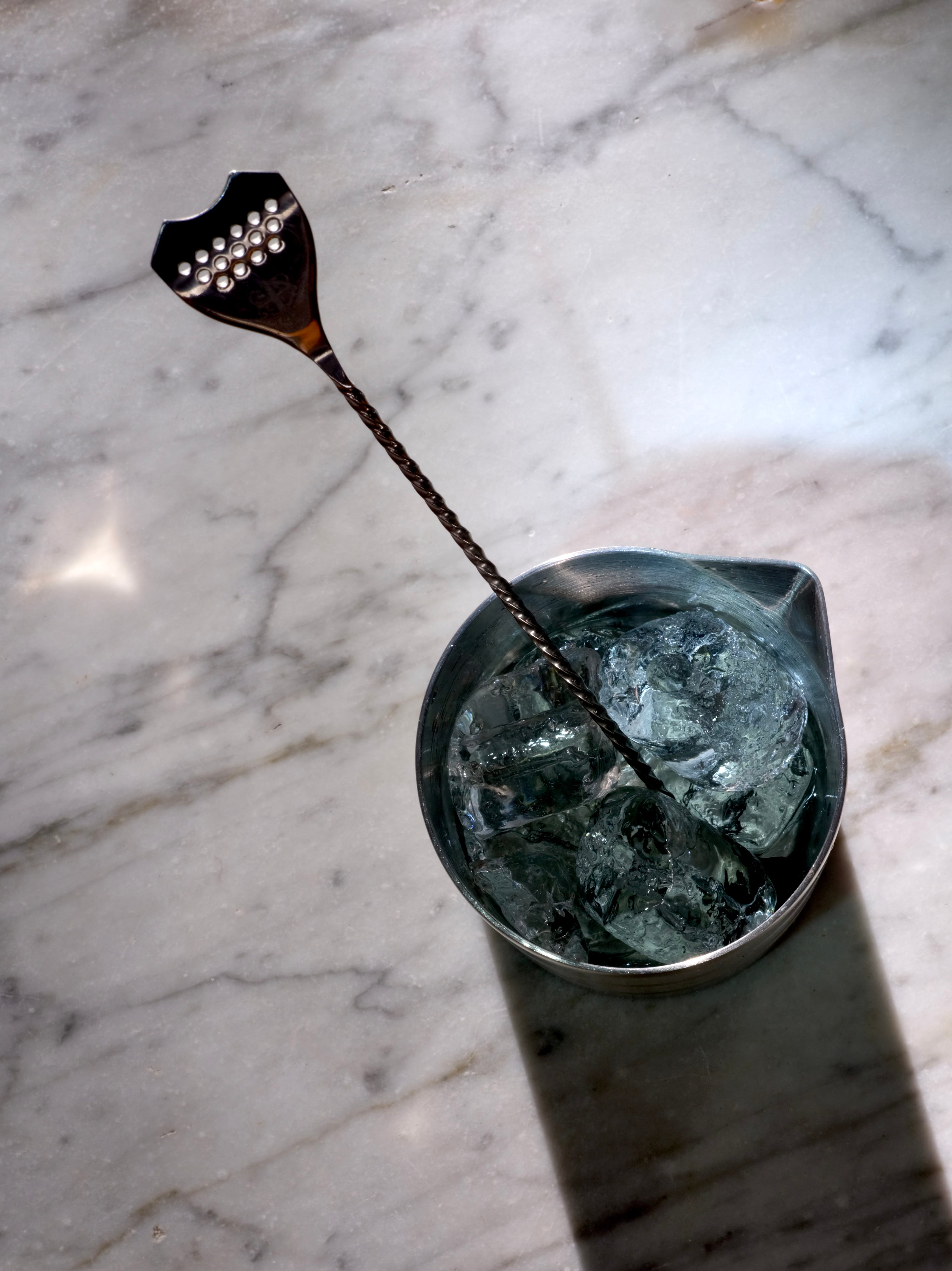
Like Cpt. Grimes in Decline and Fall, I am troubled by ‘stirrings’. No. Not that sort. The kind of stirring you do to a cocktail.
The basic rule is that cocktails containing fruit juices (or dairy, or God help us, egg), should be shaken, but the simpler ones, the ones based on a high percentage of extremely pure alcohol. You know... the Good Ones. Well they’re stirred. A slower, more contemplative process. They say that shaking a ‘martini bruises’ the gin... which is patently bollocks, but also, explains rather well the spirit of a less frenetic approach.
The big argument between shaking and stirring is usually about two groups of basically unattractive obsessives, thumbing their noses about degrees of dilution while, actually, they couldn’t be further from the truth.
Let’s do a bit of theoretical physics. You chuck a bunch of ice into a vessel, let’s say, for the sake of argument, that it’s -15ºc. You add to that a bath of drink at fridge temp. Maybe 5ºc.
The nature of thermodynamics is such that, neither of those constituent elements will rest until they reach equilibrium. The booze will chill. The ice will rise in temperature, until they both reach the same point. This will happen no matter what you do to the mixture.
(There are a few variables, like the temperature of the vessel, the stirrer and the surrounding air, but, for the sake of this thought experiment, think of it as a closed system)
Some time, if you can be arsed, mix a martini with frozen gin. Once again the ice and the alcohol will try adjust their individual temperatures until they match. But if the gin is at -15ºc and the ice is the same. neither will change at all. Nothing will get colder or warmer. The ice will not melt, so there will be no dilution. You’ll end up with neat gin, with a bunch of unmelted ice floating in it.
Add fridge temperature gin to freezer temperature ice and the the ice will warm as the gin cools. As the ice rises in temperature, it will melt. Not much, but it will melt. The amount of dilution will, eventually be a function of the difference between the starting temperatures of the booze and the ice.
I know that it feels intuitively right to think about the agitation of the ice , the physical action on it, the buggering about, to ‘speed up the chilling’. But that is ALL it does.
If you graph the drop in temperature in a stirred and a shaken cocktail, you see the same story. If the ice is at one temp and the booze is at another, the combined mess will drop to the point of equilibrium. On a neat little curve... but it will end up in at exactly the same temperature and... naturally... with exactly the same percentage dilution.
Shaking aggressively can chip off little bits of ice, which means, if you care about such things, that the perfect clarity of your drink might be compromised. Who are we kidding? Of course we care.
In a drink containing fruit juice the physical upheaval of shaking helps to homogenise the ingredients improving appearance and, in some cases texture.
The most important thing to take away when considering stirring is that you are trying to reduce the temperature efficiently while minimising what one might characterise as ‘excessive turbulence’. With this in mind, I favour what’s called Japanese style stirring, where the shaft of the stirrer is gripped loosely so it can rotate, in the fingers. The back of the spoon end is pushed agains the wall of the mixing vessel and moved carefully around. This technique, once you get the hang of it, moves all the ice, as a single mass, spinning it in the liquid. The cubes don’t move with respect to each other, just through the liquid. You start slow and speed up
The sound is glorious. A gentle swishing. If you hear a crunch of ice on ice, you’re probably moving too fast.
Try to be consistent. If you do it the the same way every time and it’ll get easier to refine.
Having wired up my stirring cup and plotted temperatures I know that the drink will not drop significantly in temperature after around 80 rotations. But I know that once equilibrium is achieved, it won’t get more dilute... so I usually count 100. Using a timer instead, this would be an approx 1 minute stir.
Not here’s an interesting thought. Once the drink is stirred and the low temperature is reached, it won’t melt any more ice for quite a while. You can leave the drink, with the ice, in the vessel while you build other drinks. You can leave half of what you’ve mixed in the vessel while you tackle the first half (I use a double-walled stainless steel mixing jug so outside temperature is not that significant. The poured drink will warm up in the glass. The stuff left in the jug won’t). And here’s the really shocking notion. You could theoretically pour your stirred martini over ‘rocks’... it would stay cold in the glass, longer, with insignificant dilution.
Next, much like Cpt. Grimes I guess, I’ll get the shakes.