
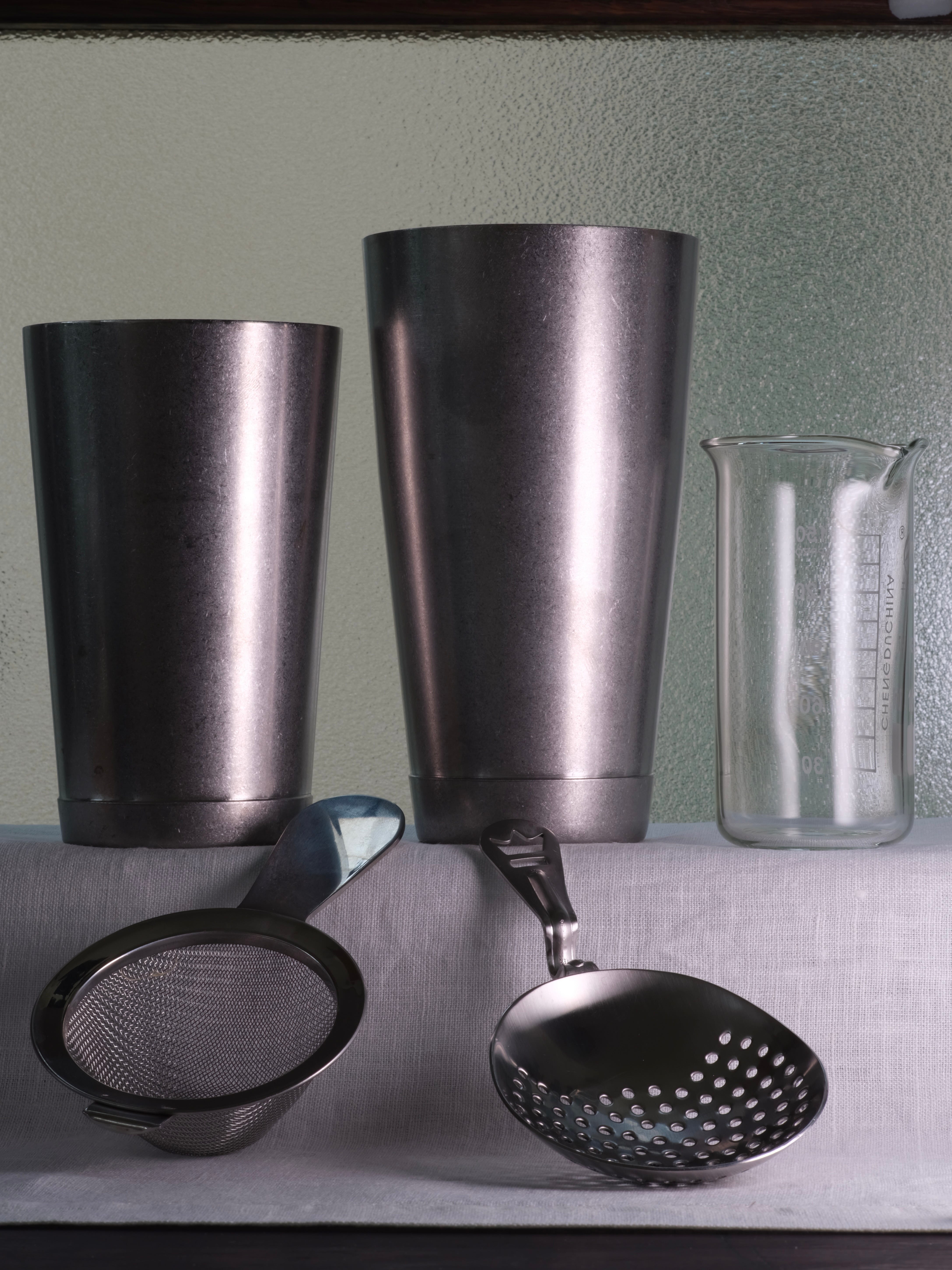
You’d be forgiven for thinking that this is the dullest cocktail picture you’ve ever seen and, I have to admit, I’m with you on that. I could have chucked a bunch of coloured lights in there, polished the tins or given it a bit of glitter, but to have done so would have missed the point.
This is my favourite shaker. It is, I think, the tenth I’ve owned. I gave a couple away to good people, lost at least one and all were, by the time they departed, unmourned.
The earliest one I can remember had belonged to my nan and was made of of smoked glass with a crackle pattern and a lid made of a sort of plastic fake bronze. It looked like something you might have bought after-shave in during the 70s. It broke when I shook ice in it.
There was a nice little silver-plate ‘Cobbler’style, German made, I think, from around 1935. The cobbler is the three-part type that’s shaped like a fat amphora. The top separates at the widest point to get ice and ingredients in, then once it’s been closed up and shaken, you can remove the smaller ‘cap’ and pour the drink through the strainer built into the neck. They’re cute. The cap doubles as a jigger measure, they never fly apart and shower everyone with Sex-on-the-Beach. Too often they jam shut, but they’re are ideal for use in student accommodation, festival tents or anywhere else where drink is needed but a full dinner jacket might not be available. Mine departed with the same girlfriend who gave it to me.
It may have been a rebound overreaction but I replaced that with the classic Alessi 870 (By Luigi Massoni & Carlo Mazzeri), a highly sought-after derivation of the cobbler, which looked outstanding on a shelf in my flat, attracted admiring comments from all and was, without shadow of a doubt, the most useless object I’d ever owned. It was too small, fiddly and made a noise like gastro-intestinal distress when shaken.
At some point I bought myself a ‘Parisian’. These are by normal aesthetic standards, the most beautiful shakers. The two parts marry in a union so perfectly engineered it hardly disrupts the smooth line of the casing. It is, if the usual Gallic bollocks is to be believed, inspired by the calves of ballet dancers. It also jams closed at the slightest provocation, permanently locking your drink inside. There are few more humiliating experiences than shaking an elegant little margarita for two and then being unable to get to it... pawing at the smooth, cold exterior with frozen fingers while it refuses,with almost palpable hauteur, to cooperate and yield.
Because of its two part design, you’ll also need a strainer for your Parisian. I like the ‘Julep’ version on the right in the picture. You can buy them with the bend already in the handle or get a straight one and bend your own to fit (pointless, but it has a certain “build your own light sabre, young Padawan” charm to it). You slide the strainer into the tin, clip the bend over the side and you can hold it in place, and hold the ice back while you pour. The ‘fine strainer’ keeps out ice shards and small bits of vegetation.
The glass object is a 150ml lab beaker. Because I weigh my ingredients for consistency, rather than using a jigger or other volumetric measure, I need something that sits on the scales and into which I can build the ingredients. Honestly? It’s a daft idea. I’m just a nerd. Use a jigger - the barman does.
Eventually, you will arrive at the Boston. The standard professional shaker which originated when some enterprising barman slammed a tin mug over a straight sided beer glass and changed the world forever.
My first was the classic glass/metal combo but then, after a long, drunken conversation with a barman, I swapped to two stainless steel tins, manufactured by a company in Japan. They arrived with a bit more shine that this but not fully polished, what would be the point? You’ll notice that the bottoms of the two halves have an extra layer. They’re sometimes called ‘weighted’, which sounds kind of rugged and weapony when the barman describes it, but weight and balance is not what it’s all about. That extra metal makes the bottom more substantial and rigid, meaning that the rest of the cup can be thin, light and flexible.
This is the beautifully simple key to the engineering genius of the Boston shaker. The larger tin, the bottom, gets filled with ingredients and ice and then the smaller tin is slid in, on a slight angle so that one side is in an entirely straight line. A sharp tap on the bottom of the lid and both elements immediately flex to seal. Better still, the rapidly chilling air inside the sealed container, contracts, creating a small but significant pressure difference, pulling top and bottom closer together and tightening the seal.
It’s that little bit of flex that does it for me. Every time I crack out the shaker, I give it a little squeeze and my heart soars. You know how churches and cathedrals were designed to put the literal ‘Fear of God’ into the congregation? How painters and sculptors were commissioned to create works to inspire by glorifying what God had wrought? I haven’t a religious bone in my body but squeezing my tin every cocktail hour inspires me. I wonder at what man’s rational, secular ingenuity has achieved in the pursuit of getting elegantly wasted.
As long as you trust it and just ‘tap’ it shut, the Boston tins never jam. They can’t, because flexing them again breaks the seal. It’s only if you lack faith, if you hammer it closed, that you’ll find yourself Embarrassed at the Bar.
History, aesthetics, physics, inspiration and faith. And who does it make you think of? Tom Cruise in a Hawaiian shirt.
No wonder humanity’s in a mess