
You must have seen it a thousand times. Tall windows letting through a late afternoon California light. The entire colour palette is of naff 70’s browns and beiges. It’s The Hawthorne Grill in Hawthorne Los Angeles and a young couple are sitting over a coffee, whispering conspiratorially.
Pulp Fiction (1996) and one of the most recognisable moments in modern cinema.
But I don’t notice Tim Roth’s fidgety, rage-fuelled malevolence, or the deranged glint in Amanda Plummer’s eyes. The spitting, hissing profanity prefiguring the hair-trigger psychopathy that will give the final scene all its tension.
No. I’m interested in the way they use the furniture.
She pulls a grotesquely overpowered hand-cannon out of her bag and hops up onto the seats. She creates a clear field of fire, and establishes dominance by scaring the living shit out of the customers. Well, all but two of them. And I’m lost in my admiration for Tarantino. Because you can’t do that sort of thing on a Thonet bentwood brasserie chair or one of those mid-century plywood school jobs they have in Hackney coffeeshops.
This, for me, is the high point of the Furniture Directing in film. What we might call The Booth Shot.
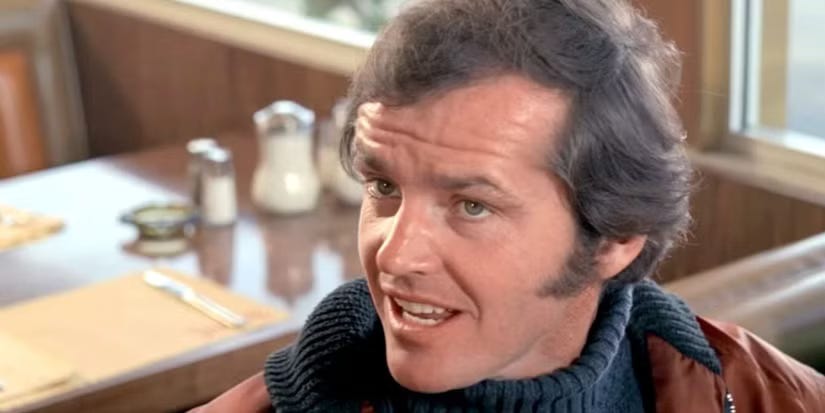
I’m fond of Jack Nicholson’s booth-work in Five Easy Pieces. (Denny’s. I5. Nr Eugene Oregon). The way he occupies it. A temporary home for the drifter. And he owns the space with a shit-eating grin, expansive manspreading and weapons-grade cockiness. The arm along the back of the bench, taking up the space of two and not giving a rat’s ass. He’s not taking petty restrictions from The Man… well the waitress anyway. Yep, that’s the kind boss level booth acting you couldn’t pull off in a tea shop.
Christ!, come to think of it, possibly the only improvement they could have made to Withnail and I would have been to have booths in the Penrith Tea Rooms (actually in Milton Keynes and now a chemist). Richard E. Grant sprawled across the banquette like a Gin-slain Chatterton. God what a magnificent bastard! Bruce Robinson was asleep at the wheel for that one.
Diner (1982), should have had the Booth on the cast list between Bacon and Barkin, and Daly, Guttenberg, Reiser, Rourke and Stern. So key it was to the idea of the space enclosing and defining a group. Barry Levinson used the booth to trap his cast of young people, like specimens in a collection and to play out the brilliant banality of their conversations and relationships
I’ve got a soft spot, at least for the visuals of Paris, Texas (1984) Harry Dean Stanton and Dean Stockton, backlit by the headlights of a Ford truck outside the window, but surely the ultimate ’Two-scenery-chewers-face-off-in-a-booth’ Oscar has to go to Michael Mann’s Heat (1995)
Directors and actors love booths as the perfect setup for for close up ‘Face acting’
Two over-shoulder cameras. Intimate work between talented protagonists where the camera and director are literally outside, excluded by the physical enclosure. They lean in. Close. Face-to-face. And Christ… they act. With two old pros like De Niro and Pacino the chemistry is insane. They don’t need anyone else. In fact De Niro insisted that the booth scene in Heat was completely improvised.
It’s the same sense of enclosure and intense intimacy that makes customers love booths. The perfect setting for a date. Business people love them for their discretion.
Though the booth powerefully signifies ‘America’ they long predate that. They were popular in the coffeeshops and chophouses of Georgian London where their discretion was valued for legal discussions, political plotting or commercial skullduggery.
We all love booths. But modern restaurant designers hate them. They are too difficult to clean. Too hard for staff to lean into, but above all, booths guarantee empty seats. Once you’ve sat Pumpkin and Honey Bunny in that big booth in the window, you’ve denied yourself a more lucrative table for six until they decide what on earth they’re chatting about over there. Customers love booths more than any other restaurant setup, but restaurants simply can’t afford them anymore.
Which is why the Park restaurant, led by Master Restaurateur Jeremy King - where, in fact, I’m writing this - is so interesting. A few booths for large groups, or favoured VIPs and then a room divided by low walls and banquettes - the padded benches in a booth - each facing out over a two-top and a regular chair. A kind of aura of boothery, but flexibility of form. Somehow they’ve had the confidence to let a few seats go empty in every sitting. It telegraphs ease, comfort, going the extra mile to make guests happy
I like it. It feels comfortable, exclusive. I feel strangely empowered and, yeah. I reckon this banquette could definitely take my weight….
“EVERYBODY BE COOL! THIS IS A ROBBERY”