
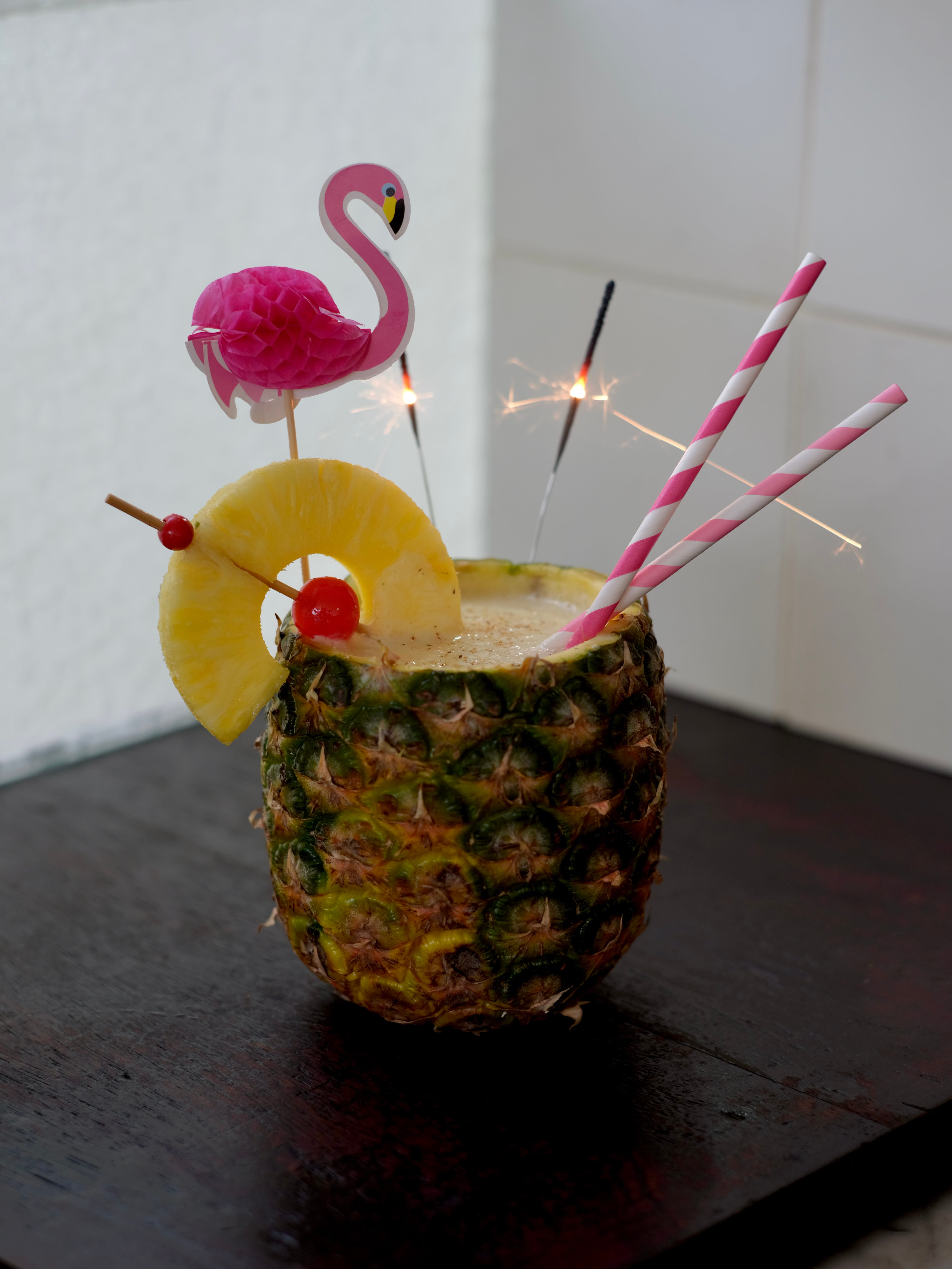
The pinã colada (it translates as strained ‘pineapple’) is not, in itself a bad idea. It’s thought to have originated in Puerto Rico in the 1920s, basically a mixture of Bacardi rum, pineapple juice and coconut cream. That’s a high fat (30-40%) product extracted from coconut ‘meat’, by grating it and extracting the oil with hot water.
The International Bartender’s Association suggest 5 rum :5 pineapple juice: 3 coconut cream, strained, and either shaken with ice or blended with it into a ‘slushy’ texture. It’s a happy little mixture. Fun, sunny and infinitely accessible. Which is probably why bartenders couldn’t leave it alone.
I spent a fair while searching contemporary recipes for the pinã colada and combined some of the ‘twists’.
Many bars serve theirs in a pineapple. This requires a special tool, available cheaply online, that you screw down into the cut top of a medium-sized pineapple, like a polar explorer taking a core sample. It’s immensely satisfying and lifts out a spiral of perfectly cut pineapple rings. A hotel or cruise ship kitchen doing enough breakfasts and fruit salads would probably empty hundreds of fruit like this every day and deliver the ‘shells’ to the bar. Strangely, I couldn’t find a single recipe that suggested using the fresh pinapple extracted for anything other than garnish. All recommended branded, prepared juices. (On top of this, several sources suggested adding sugar syrup).
Most recipes add lime juice or ‘sour mix’, which, I suppose might counterbalance the enamel stripping sweetness of the pineapple juice.
All modern recipes seem to involve the blender, which does great things to the texture, but several creditable sources suggest adding both xanthan gum (an additive used as a thickener in commercial food production) and ‘foamer’. A neutral agent that replaces egg-white.
Some modern recipes suggest that the resultant smooth, fruity, deliciously fatty cream can be chucked into a whipper bottle and served as a cold foam.
I couldn’t resist chucking everything at this one, including all the nicknacks in the props box. It’s just so silly... so fun.
Because, fundamentally, here’s nothing wrong with any of these techniques. Most of them would be easy to achieve with the facilities in a reasonable sized hotel. Though xanthan and nitrous oxide whipping were originally found in industrial food production, they are now absolutely everyday tools of ‘Molecular’ chefs.
I’d love to think of cocktails as a diverse, happily inclusive continuum from the modernist purity of the martini or the manhattan right the way over to the ‘everything in the toolbox’ pinã colada... but do they really have anything in common?
It’s not unusual to observe that an extra-large ‘seasonal’ latte from Starbucks, decaffinated, sweetened, spiced, its texture enhanced and served in a disposable sippy-bucket doesn’t have much to do with a double espresso. You can argue with the barista whether or not it’s a ‘coffee’ or what Starbucks themselves refer to as a ‘the hot beverage you are about to enjoy’.
I suppose the martini and this terrifyingly mighty ‘pinã’ are related in the sense that they are happy and fortuitous ways to ingest liquor, but I can’t get round the thought that the pineapple number does dual service. In the same way that a pumpkin spice and nutmeg festive latte can be read as a hot milkshake, a full-dress modern PC is legitimately interpretable as a delicious boozy dessert.