
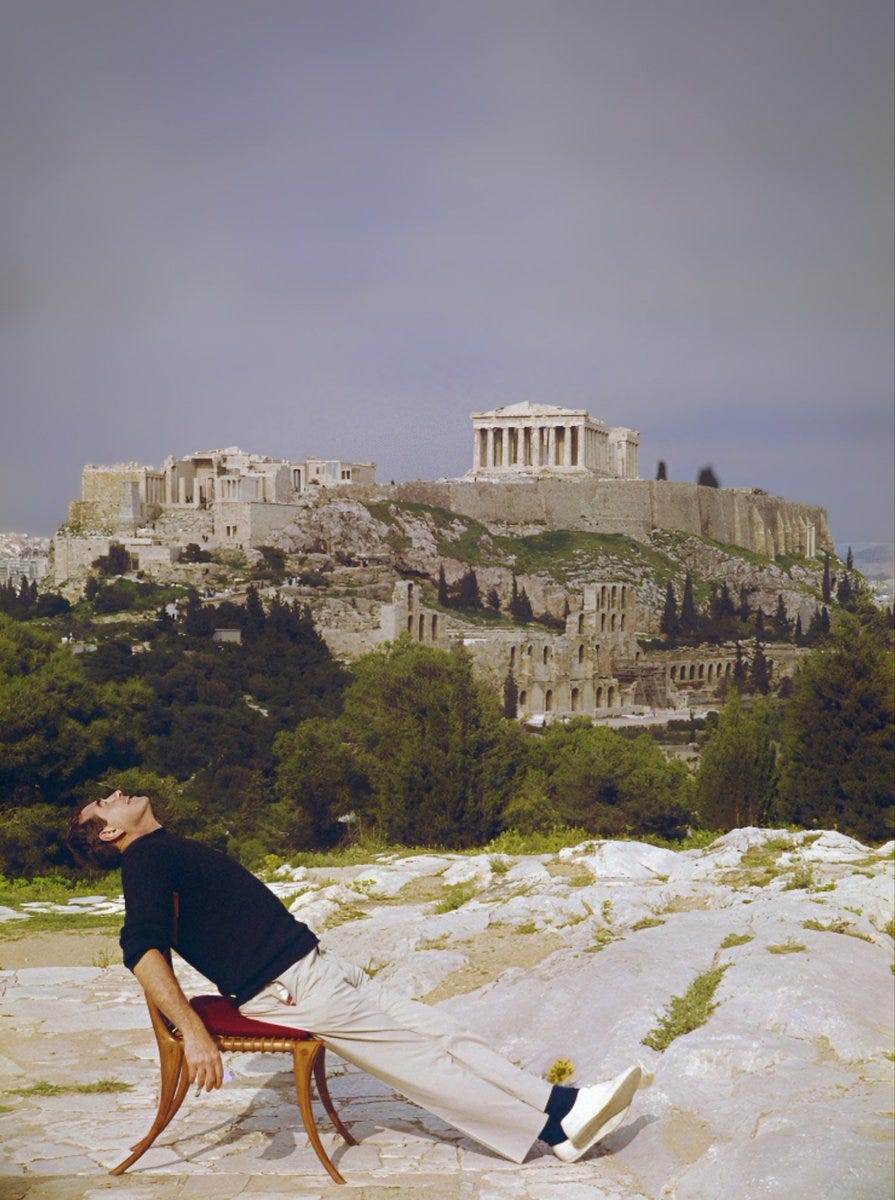
There are a couple of photographers who occupy disproportionate real estate on my bookshelves. These are widely populated shelves. Replete with the worthy and brilliant. But the two I love most, the two I get the greatest pleasure from leafing through, are Slim Aarons and Bruce Weber.
They bug people, because, I suspect, they are, on the surface, well … vacuous. They portray quite unquestioningly, unreasonably, unfashionably aspirational worlds.
Aarons came from a troubled childhood, passed between relatives and ending up in an orphanage. He went into the Army at 18, saw unimaginably horrible things in WW2, and won a Purple Heart. After he left the military, he took up commercial photography for magazines and Madison Avenue, and famously opined that the only beach worth landing on was “decorated with beautiful, seminude girls tanning in a tranquil sun.”
Weber is complicated in other ways. Married lifelong to his agent and companion Nan Bush, he has assiduously created the most solidly homoerotic corpus in photographic history. Robert Mapplethorpe ‘fearlessly’ bared his sexuality because he knew it would shock and fascinate. Weber, working contemporaneously, kept oddly quiet about having any preference, yet seemed to fully immerse in it and rub it gleefully all over himself.
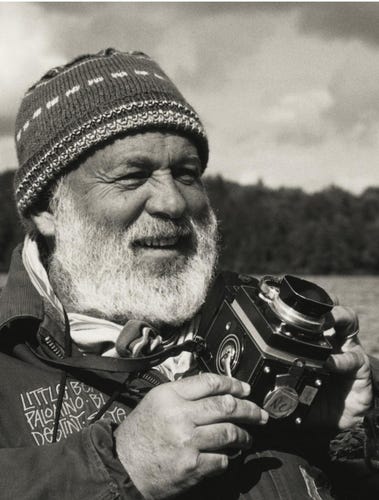
It is hard to imagine two people who *wanted* more what they’d chosen to document.
But I love them because, in an odd way, they were also ‘outside’. They were never themselves, part of the worlds they wanted so much. Sure, they were there, but as observers. By that, though, I don’t mean they were by any means ‘journalistically’ detached; in fact, they were complicatedly in love with their subject. Aarons obviously worshipped a glossy international jet set who almost certainly would never have invited him to dinner. There’s no sneaky satire in his work. He’s not photographing some millionaire, slyly staring at his young wife as if he owns her. There isn’t that Diane Arbus ‘behold the disgusting wrinkled reality of the rich at play’. He just bloody loves that he’s there. He wants that beach so bad it hurts.
Similarly Weber. It would have been so ‘clever’ to let just a hint of the meathead self-regard of some of his young models bleed through in those pristine black and whites. It could have been a timeless ‘comment’ on the dead-eyed vacuity of fashion at the peak of the Reagan Era. But no. Bruce wants to lick every one of those beautiful, gilded youths like an ice-cream. He wants to take each towering, heroic, Leni Riefenstahl demigod, and climb him like a fucking tree.
There are plenty of far worthier, far less problematic photographers on the shelf, but these two speak to me - and possibly not through their actual images. Their lives had made them greedy enthusiasts for very particular things, and they, in an inspiringly direct way, lived out their enthusiasms through their work. And the enthusiasm... the love... transcends the content.
As it happens, I think some of Aarons pictures have achieved a status of ‘unintended’ art, by a combination of vintage, evocativeness and sheer technical skill. (The Winged Victory of Samothrace almost certainly wasn’t the most significant piece of art in the world in the C2nd BC... but it’s technically excellent and it’s the only example we have to work with.)
Arguably, Weber’s work was significant in a larger cultural movement changing public attitudes to beauty and sexuality. Some of Weber’s films achieve a degree of artistic acceptance. Possibly because they were pitched into the smaller, more pointedly un-commercial world of pre-digital independent film, rather than International commercial photography.
But we are emphatically not talking about high art here. Both photographers shot for magazines and fashion houses. They were enmeshed in commercial mass communication and made no attempt to subvert it, to distance themselves from the influence of their clients, nor to express higher ideas...
... except love. And that, rather successfully.
This is the finest example I can find of ‘vicariety*’. Both Weber and Aarons make pictures in which their vicarious pleasure is explicit. That gives us permission to join in the enjoyment, through, and with them. Their work is populist, in the sense that it speaks directly to something shared by a vast number of people who wouldn’t know an ‘art’ photograph if it fell off a gallery wall and crushed their foot.
So why am I talking about this?
Because Jim Harrison wrote about food like this. So did MFK Fisher. So does Nigella Lawson. So does Marina O’Loughlin about restaurants. Weirdly, I don’t think Bourdain wrote like that, but it was the absolute core of his style as a TV presenter. Andrew Jefford writes like that about wine. So does Dan Keeling.
Because I think Aarons and Weber, weirdly say something about the writing I admire. About what I write, and why I write it, and the direction in which I want to take it.
In short, I aim for greater vicariety. And, inspired by Jim, Mary, Nigella, Marina, Anthony, Andrew and Dan, I’m striving to get Slimmer, and more Bruce.
*I apologise for a shameful coinage. This is something I’m working on at the moment, and it’s occupying my mind disproportionately. It comes out of a strand of conversations with various people, about ‘What AI can’t do’ - a sort of exercise in ‘Reverse Benchmarking’. I’ll explain more fully as soon as I’ve worked out a coherent argument.